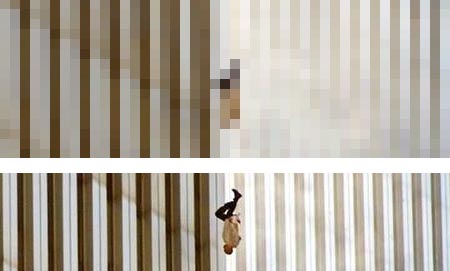
Home / The Dump Blog Falling Pixels Sep 04, 2007 photography Share Favorite Difficile de regarder lââ¬â¢homme qui tombe du World Trade Center sans traquer lââ¬â¢Ã©vidence qui oscille entre lââ¬â¢indicible et lââ¬â¢impensable. Au-delàde la symbolique de lââ¬â¢Ã©vénement cet instant touche une autre de nos terreurs. Notre capacité de projection est prise en défaut car elle se heurte àla dernière barrière de notre système de survie, celle qui nous retient de penser : pourquoi vivre plutôt que rien ? Dans la photographie, la question reste définitivement en suspend. La précision de lââ¬â¢image semble neutraliser la puissance tragique du sujet. Trop net pour être vrai. La structure régulière de la façade accentue la dimension formelle de lââ¬â¢image. Que se passe-t-il quand on vide progressivement lââ¬â¢image du détail, quand la pixellisation àoutrance ne laisse plus entrevoir que trois pixels qui bougent imperceptiblement forçant notre esprit àimaginer lââ¬â¢horreur, franchisant décisivement la barrière de la distanciation, chauffant àblanc le médium aurait dit McLuhan? On se demandait ce quââ¬â¢on pouvait enlever àlââ¬â¢homme pour quââ¬â¢il cesse dââ¬â¢Ãªtre homme, il faut se demander ce quââ¬â¢on peut enlever àla représentation pour quââ¬â¢elle cesse de représenter, pour mieux toucher. Comme résultat de cette gestalt dynamique, la force émotionnelle est ici dââ¬â¢autant plus forte que la vidéo, en boucle, anime les pixels avec la lenteur paisible de lââ¬â¢inéluctable. It is difficult to watch a man falling from the world trade centre without attempting to track down evidence of something between the indescribable and the unthinkable. Beyond the symbolism of the event, the instant touches on another of our fears. We are, here, unable to use our capacity to project, having come up against the final barrier to our survival system, the one which prevents us from asking ourselves: why live rather than nothing? In photography, the question remains permanently suspended. The precision of the picture seems to neutralise the powerful tragedy of the subject matter. It is too clear to be real. The regular structure of the façade accentuates the formal aspect of the image. What happens if we progressively empty the image of its detail, when extreme pixelisation only enables us to glimpse three pixels moving barely perceptibly and forcing our mind to imagine the horror, deliberately stepping over the barrier of distance, heating the medium until it is white hot, to quote McLuhan. We asked ourselves what could be removed from a man to make him no longer a man, and we must in fact ask ourselves what can be removed from representation for it to stop representing and affect us more. As a consequence of this dynamic gestalt, the emotional force is all the stronger here as the video, projected non-stop, makes the pixels move with the slow peacefulness of the inevitable.